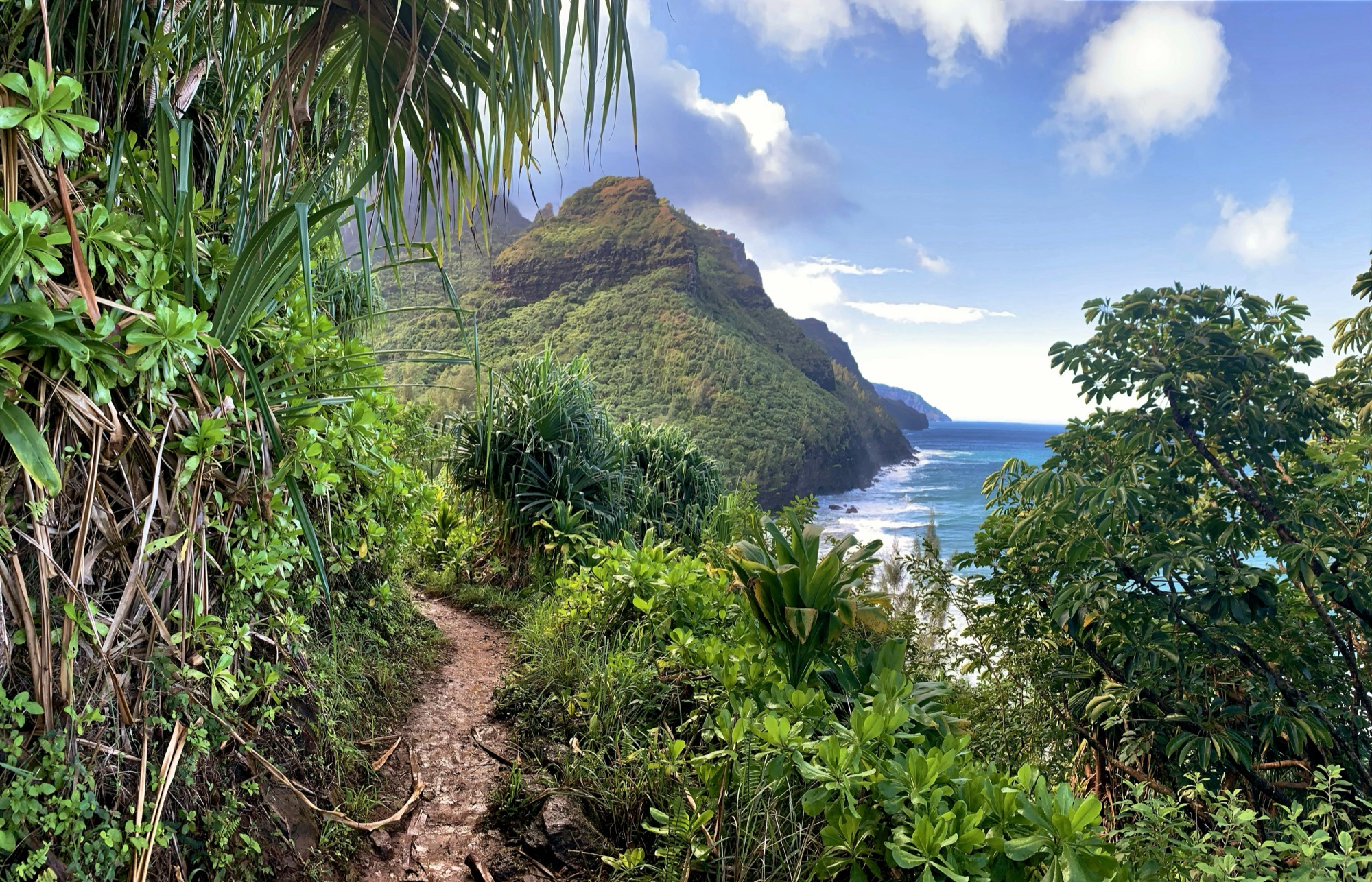
The Kalalau Trail runs 11 miles one-way along the Napali Coast from Ke'e Beach to Kalalau Beach. It's the only land access to one of the most isolated stretches of coastline in the United States. It's also dangerous, regulated, and frequently misunderstood by visitors who saw it on Instagram.
Let's get the basics clear before anything else: this is not a casual hike. The full trail requires permits, multi-day commitment, and a realistic assessment of your fitness and risk tolerance. The first two miles are accessible to any reasonably fit day hiker. Everything beyond that is a different undertaking entirely.
The trail is maintained by the Hawaii Division of State Parks and subject to closures after storms. Check current conditions before booking any permits — trail closures can happen with little notice and permits are non-refundable.
What the trail actually is
The first two miles to Hanakapiai Beach are a day hike open to anyone with a Ha'ena State Park day-use reservation. Beyond Hanakapiai requires a Napali Coast State Wilderness Park camping permit, full stop. There is no day-hike option past mile 2.
From Hanakapiai you can detour 2 miles inland to Hanakapiai Falls — a popular add-on, technically requiring the same camping permit (rangers check), and enforcement has increased significantly in recent years. Don't plan to do this add-on without a permit.
The full trail breaks into distinct sections: Miles 1–2 to Hanakapiai (steep, slippery, heavily trafficked). Miles 2–6 from Hanakapiai to Hanakoa (remote, multiple stream crossings, significantly harder). Miles 6–11 from Hanakoa to Kalalau (the hardest section, includes Crawler's Ledge, most remote).
Hanakoa Valley at mile 6 has a designated camping area and is the logical midpoint for backpackers doing the full trail. Many experienced hikers break it into: Day 1 Ke'e to Hanakoa (camp), Day 2 Hanakoa to Kalalau (camp 1–3 nights), return via same route.
There are no emergency services along the trail. Helicopter rescue costs thousands of dollars and is only available in weather that permits flight. The state will bill you for rescues deemed negligent.
The permit process
Day-use parking and shuttle reservations for Ha'ena State Park open at gohaena.com 30 days in advance and sell out in minutes for popular dates. Set a calendar reminder for exactly 30 days before your hike date, 12:00 AM Hawaii time (which is 6:00 AM Eastern the day before for east coast visitors).
Overnight Kalalau permits are issued through camping.ehawaii.gov, 90 days in advance, also instantly sold out. $35/night for non-residents, max 5 nights total in any 30-day period at Kalalau.
Without a permit, the rangers at the Hanakapiai checkpoint will turn you around. Fines for trespassing past Hanakapiai start at $250. Rangers are present at the checkpoint most days and on the trail beyond it.
Permit strategy: set reminders for both the 90-day window (for Kalalau camping) and the 30-day window (for the Ha'ena day-use entry). If you miss both, cancellations do appear — check the booking site daily in the week before your trip. Don't attempt the trail without proper permits and assume enforcement is active.
Shoulder season (late April/early May and October) has slightly better permit availability than peak summer. The trail is also better in these windows: less crowded, often drier than winter, and the summer humidity hasn't fully set in.
If Kalalau permits are unavailable, the Hanakapiai day hike with a Ha'ena reservation is still one of the best day hikes on Kauai. Don't skip it just because you can't get the full permit.
Difficulty, honestly
The first 2 miles to Hanakapiai are rated 'moderate' by the state, which is generous. It's 800 feet of elevation gain on muddy, rooted, often slippery trail. Expect 2–3 hours round trip even for fit hikers. Trail runners crush it in an hour each way; vacationers in flip-flops twist ankles every single day.
The full 11 miles to Kalalau is one of the harder backpacking routes in the U.S. The combination of technical terrain, humidity, weight on your back, and multiple water crossings makes it considerably harder than a comparably long trail in dry conditions.
Crawler's Ledge (mile 7) is a 2-foot-wide section with a several-hundred-foot drop and no rope. It is not technical climbing, but it is not for people who panic about exposure or have a fear of heights. Most people cross it fine; it's the mental barrier, not physical capability, that stops people.
Stream crossings: after heavy rain, several crossings become genuinely dangerous. The Hanakapiai Stream at mile 2 has killed people who tried to cross it when it was flooded. The rule is simple: if water is above your knees and moving fast, don't cross. Wait. This is not a suggestion.
Plan two days in, two days out for the full trail as a minimum. Strong backpackers with light packs do it in a single push but arrive at Kalalau too exhausted to enjoy it. The valley itself is the destination — give yourself time there.
Fitness benchmark: if you can comfortably do a 10-mile day hike with 2,000 feet of gain in under 6 hours while carrying a daypack, you are physically capable of the full Kalalau. If that sounds like a stretch, do the Hanakapiai day hike and call it a success.
What to pack
Water filter or purifier — there's running water from streams but it's not drinkable raw. Leptospirosis is endemic in Hawaii's streams and is a serious bacterial infection. A Sawyer Squeeze or SteriPen are both good choices.
Trekking poles. Half the trail is mud and the descents are steep. Poles will save your knees and keep you upright on slippery root sections.
Tent with a rain fly that actually works — not a stuff-sack-compression tent with a vestigial fly. It rains at Kalalau. It often rains at Hanakoa. Your gear will get wet if it can get wet.
Dry bags or stuff sacks inside your pack. Pack covers leak in sideways rain. Put your sleep system, electronics, and clothes in waterproof bags regardless.
More food than you think you need. There is nothing at Kalalau and no resupply option. Plan 2,500–3,500 calories per day and carry extra. High-calorie density food (nuts, bars, freeze-dried) is worth the premium.
Headlamp, first aid kit with blister treatment (blisters are nearly universal on this trail), sun protection for the exposed sections, and a way to signal for help in an emergency. Cell service is nonexistent past mile 1.
Footwear: trail runners are the preferred choice over heavy hiking boots. The trail is wet and your feet will get wet — quick-drying shoes matter more than waterproofing. Gaiters help with mud and debris.
Camping at Kalalau
The beach is a half-mile of sand backed by a sea cave and a waterfall (Ho'ole'a Falls) you can shower under. There are pit toilets at the designated camping area. There is no trash service — pack out everything, including food scraps, human waste from wag bags (required), and toilet paper.
Goats roam the valley. Monk seals haul out on the beach. Do not feed anything, do not approach the seals (50 ft minimum), and do not camp on the seaward side of the marked sites — surge waves have killed campers who didn't take the signs seriously.
The camping area is marked with posts — use only designated sites. The valley beyond the camping area is accessible for day exploration: Kalalau Valley goes back several miles and the waterfall hike to the back of the valley is one of the highlights of the trip.
Water at Kalalau comes from a stream at the valley entrance. Filter everything — the goats graze upstream. The campground area water source is reliable in most seasons but can slow to a trickle after extended dry spells.
Night sounds: the valley is extraordinarily alive at night — waves, frogs, roosters before dawn. The sea cave is visible from the beach and walking to it at night with a headlamp is memorable. The stars here, far from any light pollution, are exceptional.
Wag bags are required for all human waste and are provided at the trailhead kiosk. This is enforced. Pack in, pack out for all solid waste — the valley's ecosystem is fragile and there's no sanitation infrastructure.
What not to do
Don't swim at Hanakapiai Beach. The sign listing drowning deaths is not a souvenir — it's been updated regularly because people ignore it. The shore break and currents at Hanakapiai have killed experienced ocean swimmers. Walk the beach, appreciate the scenery, don't enter the water.
Don't hike past Hanakapiai 'just to see it a little further' without a permit. The checkpoint is at Hanakapiai and rangers regularly check IDs against the permit system. The fine starts at $250 and the hike back is the same distance either way.
Don't start the full trail in the afternoon. People get caught after dark on Crawler's Ledge every year. If you're doing the Hanakapiai day hike, start no later than 9am. If you're doing the full trail to Hanakoa, start at first light.
Don't hike after heavy rain without checking stream conditions. Hanakapiai Stream and several crossings beyond it become impassable after significant rain. The stream can rise from ankle-deep to waist-deep in 30 minutes. If it rained hard in the last 24 hours, reassess.
Don't underestimate the exit. The last miles back to Ke'e on the return trip are just as hard as the first miles in, but you're carrying a pack you've lived out of for days and your legs are already tired. The Pu'u o Kila section (miles 9–11 on return) has caught many people out late when they thought they were almost done.
Was this guide helpful?